




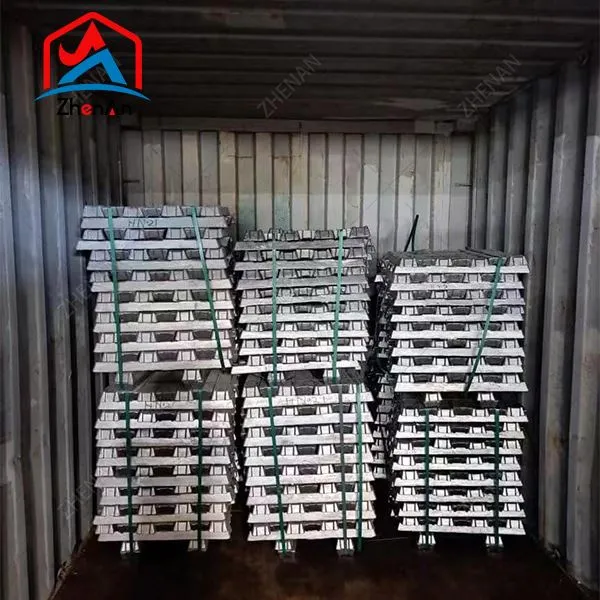


Pure Metal 99.994% Tin Ingot With Cheap Price
| Purity(%) | As | Fe | Cu | Pb | Bi | Sb | Cd | Zn | Al | Total |
| 99.99 | 0.0005 | 0.0025 | 0.0005 | 0.0035 | 0.0025 | 0.002 | 0.0003 | 0.0005 | 0.0005 | 0.01 |
| 99.95 | 0.003 | 0.004 | 0.004 | 0.01 | 0.006 | 0.014 | 0.0005 | 0.0008 | 0.0008 | 0.05 |
| 99.90 | 0.008 | 0.0025 | 0.008 | 0.04 | 0.015 | 0.02 | 0.0008 | 0.001 | 0.001 | 0.1 |
Why are High Purity Tin Ingots indispensable for industrial applications?
High Purity Tin Ingots are indispensable for industrial applications because they provide the material integrity, performance consistency, and reliability required for critical operations across a wide range of industries. With purity levels typically exceeding 99.9%, these ingots are free from impurities such as lead, iron, or sulfur, which could compromise the strength, corrosion resistance, or conductivity of the final product.
In electronics manufacturing, high purity tin is the foundation of lead-free solders used in circuit boards, semiconductors, and consumer devices. Its ability to form reliable, corrosion-resistant joints ensures the long-term performance of electronic systems, even under thermal cycling and mechanical stress. The high purity also minimizes the formation of intermetallic compounds, which can weaken solder joints and lead to failure in critical applications.
In metallurgy, high purity tin is used to produce high-performance alloys such as bronze, pewter, and bearing alloys. These alloys are essential for industrial applications like marine hardware, machinery components, and precision instruments. The addition of high purity tin enhances the hardness, corrosion resistance, and machinability of these alloys, ensuring they meet the demanding requirements of industrial use.
High purity tin is also widely used in coatings and plating, such as tinplate for steel, which is applied in industries like food packaging, construction, and automotive manufacturing. The tin coating provides a protective, non-toxic, and corrosion-resistant layer that extends the lifespan of the base material, meeting the quality and safety standards of industrial applications.
Additionally, high purity tin supports sustainable manufacturing practices by enabling the recycling of alloys without significant property loss. Its consistent performance and compliance with international standards (e.g., RoHS, REACH) make it a trusted material for professionals who require dependable solutions for their industrial processes.

