





Graphite Electrode
Your Professional Graphite Electrode Supplier
ZhenAn New Metal Co., Ltd. is located in Anyang City, Henan Province, the hometown of Oracle in China. We are a professional metal materials exporter with more than 30 years of experience in metal production.In addition, we also have 200+ employees and 2 production plants, each covering an area of more than 30,000 square meters. The annual output of metal materials exceeds 150,000 tons, including: tantalum metal, zirconium metal and niobium metal.


Why choose us
Quality assurance
Zhenan operates a very strict quality control system, including raw material selection, production control, product inspection, fine packaging and delivery. All products undergo rigorous analysis and each order is inspected by relevant processes before shipment.
Professional service
With extensive experience in high-purity materials, we can help customers select materials, design products and provide technical support. We have independent laboratories to develop and test new materials and provide technical consultation to customers.
Customized services
Which can accept your customized needs for product packaging and logistics. If you need to customize your own logo on the packaging, no problem, we can fully meet your needs.
Graphite Electrode
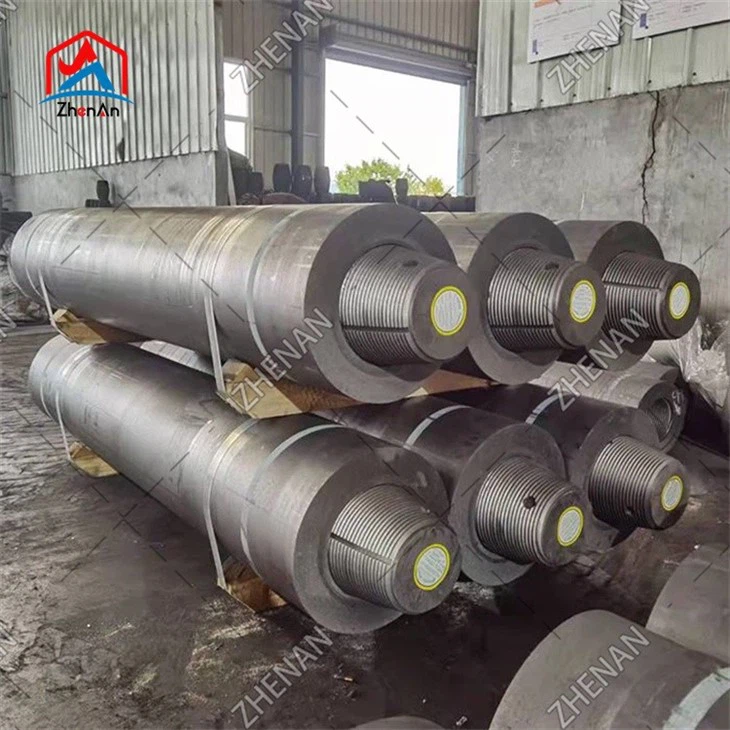
Graphite electrodes are kind of conductive material in electric arc furnace steelmaking production. The graphite electrodes are mainly made of petroleum coke and needle coke as raw materials, and coal pitch is used as a binder, and is made by calcination, batching, kneading, pressing, roasting, graphitization, and machining. Due to some special properties of graphite. It is a conductor that releases electrical energy in the form of an electric arc to heat and melt the charge in the electric arc furnace. According to its quality index, it can be divided into rp graphite electrode, high power graphite electrode and ultra high power graphite electrode.
|
Physical Properties |
RP Grade |
HP Grade |
UHP Grade |
|
|
(Dia.50-600mm) |
(Dia.50-600mm) |
(Dia.50-600mm) |
||
|
Electrical Resistance (max) μΩ-m |
Electrode |
<8.0 |
<7.0 |
<6.0 |
|
Nipple |
6.5 |
5.5 |
5 |
|
|
Bending Strength (min) Mpa |
Electrode |
11 |
12 |
12 |
|
Nipple |
14 |
14 |
16 |
|
|
Elastic Modulus (max) Gpa |
Electrode |
9 |
12 |
12 |
|
Nipple |
12 |
14 |
14 |
|
|
Bulk Density (min) g/cm3 |
Electrode |
>1.58 |
>1.65 |
>1.68 |
|
Nipple |
>1.70 |
>1.72 |
>1.73 |
|
|
C.T.E (max) ×10-6/C |
Electrode |
2.7 |
2.5 |
2.4 |
|
Nipple |
2.5 |
2.2 |
2.0 |
|
|
Ash (max) % |
Electrode |
<0.30 |
<0.30 |
<0.20 |
Features of Graphite Electrode
High Conductivity
They efficiently conduct electricity, which is essential for melting scrap metal in electric arc furnaces.
Durability
Graphite electrodes can withstand extreme temperatures and harsh conditions within furnaces, making them reliable for continuous use.
Cost-Effectiveness
Using graphite electrodes allows for the recycling of scrap metal, reducing costs and minimizing environmental impact in steel production.
Advantages of Graphite Electrode
Extreme Temperature Resistance
Graphite can sustain and perform at temperatures exceeding 3000°C without melting.
High Conductivity
Its excellent electrical conductivity ensures minimal power loss during operation.
Mechanical Strength
Properly manufactured electrodes can withstand the stress and vibration of high-energy furnace environments.
Thermal Shock Resistance
Graphite's molecular structure allows it to tolerate rapid temperature changes without cracking.
Eco-Efficiency
When paired with EAF technology, graphite electrodes contribute to lower CO₂ emissions compared to traditional blast furnace methods.
Type of Graphite Electrode
Rp graphite electrode
Produced with ordinary grade petroleum coke. Graphitization temperature is low, its resistivity is high, the coefficient of linear expansion is large, and its thermal shock resistance is poor, so the current density is allowed to be low.
HP graphite electrode
Produced with high-quality petroleum coke (or low-grade needle coke). Sometimes the electrode body needs to be dipped. Its physical and mechanical properties are higher than those of ordinary power graphite electrodes, such as low resistivity, which allows a large current density.
UHP graphite electrodes
Must be produced with high-grade needle coke. And the graphitization heat treatment should be carried out in the internal graphitization furnace. The graphitization temperature is as high as 2800 ~ 3000 ° C. Therefore, the resistivity is lower, allowing greater current density, the linear expansion coefficient is smaller, and has excellent thermal shock resistance.
Uses of Graphite Electrode
Electric Arc Furnaces (EAF): Graphite electrodes are widely used in EAFs for steelmaking. They conduct electricity to generate the high temperatures required to melt scrap steel and produce new steel.
Foundries: In foundries, graphite electrodes are used for melting metals and alloys in induction furnaces. Their ability to withstand high temperatures makes them ideal for this application.
Aluminum Production: They are also employed in the production of aluminum, particularly in the electrolytic reduction process, where they serve as anode materials in Hall-Héroult cells.
Chemical Industry: Graphite electrodes are utilized in various chemical processes, including the production of silicon and other non-ferrous metals. They can withstand corrosive environments and high temperatures.
Battery Production: In the manufacture of lithium-ion batteries, graphite serves as a key component for anodes due to its high electrical conductivity and capacity for lithium intercalation.
Research and Development: Graphite electrodes are used in laboratories for various experimental setups, including electrochemical studies and material characterizations.
Electrolysis: They are also used in electrolysis processes for producing chlorine and caustic soda, as well as in other electrochemical applications.
Other Applications: Graphite electrodes find applications in the production of carbon composites, in the semiconductor industry, and as components in various electrical devices due to their thermal and electrical properties.
Key Materials Used in Graphite Electrode Production
Needle Coke
This is the main raw material for graphite electrodes. Needle coke is a high-quality petroleum coke with low sulfur and metal content. Its unique needle-like structure makes it ideal for creating strong carbon products.
Pitch
This is a binder that holds the carbon particles together. Derived from coal tar, pitch is essential for shaping the electrodes.
Boron Compounds
Occasionally added to improve the electrodes’ properties, boron can enhance both thermal and electrical conductivity.

The Manufacturing Process of Graphite Electrodes
Mixing Raw Materials
The process starts by mixing needle coke and pitch in precise amounts to create a paste-like mixture. This mixture is then shaped into cylindrical forms using molds.
Baking the Electrodes
The shaped electrodes are baked at temperatures around 1000°C (1832°F). This step carbonizes the pitch, removing volatile substances and forming a solid structure. Controlled baking and cooling are vital to prevent cracks and ensure even density.
Impregnation
After baking, the electrodes go through a pitch impregnation process. This step fills any pores created during baking with additional pitch to enhance density and strength. This process may be repeated several times for optimal results.
Rebaking
The impregnated electrodes undergo a secondary heat treatment, or rebaking, at temperatures below 800°C (1472°F). This process carbonizes the additional pitch, further improving the electrodes’ density and mechanical properties.
Graphitization
The most critical step is graphitization, where the baked carbon is transformed into graphite. This is done by heating the electrodes to about 3000°C (5432°F) in an electric furnace. The graphitization process can take from a week to a month, depending on the furnace type.
Machining
Once cooled, the graphite electrodes are machined to precise dimensions. This step ensures that the electrodes meet specific requirements for their intended applications, including threaded ends for easy installation in furnaces.
Quality Inspection
Before shipping, each batch of electrodes undergoes thorough quality inspections. This includes measuring physical properties and conducting visual checks to ensure they meet industry standards.
Precautions for using the graphite electrode:
Wet graphite electrodes must be dried prior to use.
The foam protective caps on the electrodes socket shall be removed to verify the integrity of the internal threads of the electrode socket.
The surfaces of the electrodes and the internal threads of the socket shall be cleared by compressed air free of any oil and water. No steel wool or metal sand cloth shall be used in such clearance.
The nipple must be screwed carefully into the electrode socket of one end of the electrode without collision with the internal threads t is not suggested to directly put the nipple into the electrode removed from the furnace)
The lifting appliance (it’ s preferred to adopt graphite lifting appliance) should be screwed into the electrode socket of the other end of the electrode
When lifting the electrode, cushion-like materials must be put on the ground under the connecting end of the electrode to avoid any collision. After the lifting hock has been put into the ring of the lifting appliance. The electrode shall be lifted smoothly to prevent it from falling or colliding with any other fixture.
The electrode shall be lifted above the head of the working electrode and dropped slowly aiming at the electrode socket. Then the electrode will be screwed to make the helical hook and the electrode declining and tuning together. When the distance between the end faces of two electrodes is 10-20mm, the two end face of the electrodes and the outer part of the nipple must be cleared again by compressed air. Finally the electrode must be laid gently, or the threads of the electrode socket and nipple will be damaged because of the violent collision.
Use torque spanner to screw the electrode until the end faces of the two electrodes contact closely(the gap of correct connection between the electrodes is less than 0.05mm).
FAQ
We're professional graphite electrode manufacturers and suppliers in China, specialized in providing high quality customized service. We warmly welcome you to buy graphite electrode at competitive price from our factory. Contact us for more details.
Graphite rod electrode, Ultra-high power graphite electrode, UHP Graphite Electrode