How Does Tantalum Wire Contribute to Electronic Component Reliability?

Dec 15, 2025

Leave a message


How Does Tantalum Wire Contribute to Electronic Component Reliability?

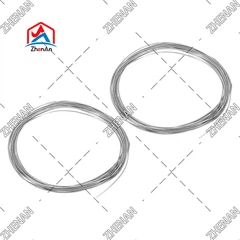
Wire Tantalum (Ta), especially High Purity Tantalum Wire​ and Pure Ta Tantalum wire (99.95%), plays a vital role in enhancing the reliability of electronic components such as capacitors, sensors, and high‑temperature conductors. Its contribution stems from a unique combination of chemical purity, stable oxide formation, mechanical consistency, and environmental resilience.
1. Stable Dielectric Formation
In solid tantalum capacitors, Pure Ta Tantalum wire (99.95%)​ is etched to increase surface area and then anodized to form a thin, uniform layer of Ta₂O₅, which acts as the dielectric. The high purity ensures fewer conductive impurities, reducing leakage current and increasing breakdown voltage stability over time. This translates into long operational life and consistent performance in critical circuits.
2. Corrosion & Contamination Resistance
Thanks to the passive oxide layer, High Purity Tantalum Wire​ resists attack from most acids, alkalis, and humid environments. This prevents corrosion‑induced degradation of connections or capacitor anodes, a common failure mode in less noble metals. Pure Metal Tantalum wire​ also shows this resistance, though 99.95%​ grade offers superior long‑term stability.
3. Mechanical Consistency
The predictable tensile strength and ductility of Wire Tantalum (Ta)​ mean leads and internal connections maintain structural integrity despite thermal cycling and vibration. This reduces open‑circuit risks in aerospace, automotive, and medical electronics.
4. Electrical Stability Over Temperature
Tantalum's resistivity changes predictably with temperature, and its oxide dielectric remains effective across a wide range, ensuring signal fidelity in precision analog and RF circuits.
5. Biocompatibility for Implantable Devices
In medical electronics (e.g., neurostimulators), Pure Ta Tantalum wire (99.95%)​ ensures no electrochemical reaction with body fluids, enhancing both patient safety and device longevity.
By minimizing failure mechanisms-leakage, corrosion, mechanical fatigue-High Purity Tantalum Wire​ and Pure Ta Tantalum wire (99.95%)​ directly improve the Mean Time Between Failures (MTBF) of electronic systems.
Reliability Factor
Contribution of Tantalum Wire
Dielectric stability
Uniform, low‑defect Ta₂O₅ layer from high purity
Corrosion resistance
Passive oxide prevents environmental attack
Mechanical integrity
Ductility & strength withstand vibration/thermal cycling
Electrical constancy
Predictable resistivity/temp relationship
Biocompatibility
Safe for long‑term implantable electronics


What Are the Differences in Performance of Tantalum Wire Under Vacuum and Air Conditions?

The performance of Wire Tantalum (Ta), including High Purity Tantalum Wire​ and Pure Metal Tantalum wire, varies significantly between vacuum and air due to oxidation behavior and outgassing characteristics.
1. Vacuum Conditions
No Oxidation: In high vacuum (≤ 10⁻⁵ mbar), tantalum remains metallic and free of oxide volatilization.
Low Outgassing: Pure Ta Tantalum wire (99.95%)​ exhibits extremely low vapor pressure and outgassing, preserving ultra‑high vacuum (UHV) integrity in electron tubes, space sensors, and analytical instruments.
Stable Thermal Properties: Retains strength and conductivity up to ~2000 °C without mass loss, ideal for furnace elements and vacuum furnace supports.
2. Air Conditions
Oxidation Threshold: Above ~500 °C in air, the protective Ta₂O₅ layer becomes volatile, leading to gradual material loss and contamination of surroundings.
Surface Degradation: Prolonged exposure at elevated temperatures causes discoloration and roughening, reducing corrosion resistance over time.
Limited High‑T Use: In air, safe continuous use is generally below 300–400 °C for Pure Metal Tantalum wire; higher temperatures accelerate oxide volatilization.
Room Temperature: At ambient conditions, High Purity Tantalum Wire​ forms a stable, self‑healing oxide, offering excellent corrosion resistance in air.
Practical Implication: For high‑temperature applications, vacuum or inert gas shielding is mandatory to exploit the full performance of Wire Tantalum (Ta). Pure Ta Tantalum wire (99.95%)​ is especially chosen for vacuum electronics because its ultra‑low impurity content minimizes outgassing.
Condition
Oxidation
Outgassing
Max Stable T
Key Use
Vacuum
None
Very low
~2000 °C
UHV components, space hardware
Air (<500 °C)
Stable oxide
Negligible
~500 °C
Ambient corrosion‑resistant parts
Air (>500 °C)
Volatile oxide loss
Increases
< 500 °C continuous
Not recommended for high‑T


What Are Maintenance Tips for Tantalum Wire in Long‑Term Use?

Maintaining Wire Tantalum (Ta), particularly High Purity Tantalum Wire​ and Pure Ta Tantalum wire (99.95%), is essential to preserve performance over years of service in demanding environments.
1. Storage Conditions
Keep in a dry, temperature‑controlled​ environment (20–25 °C, humidity < 40 % RH).
Use vacuum or argon‑filled packaging​ to prevent moisture and oxygen contact, especially for High Purity Tantalum Wire​ whose surface purity is critical.
2. Handling Practices
Wear clean, lint‑free gloves​ and use non‑metallic tools to avoid oil, dirt, or particulate contamination.
Avoid mechanical shocks or over‑bending; use mandrels for forming to prevent work hardening and microcracks.
3. Cleaning & Inspection
If surface contamination occurs, clean gently with approved solvents (ethanol, acetone) followed by drying in inert gas.
Periodically inspect for discoloration, pitting, or oxide thickening (sign of overheating in air).
4. Operational Environment
In high‑temperature service, ensure vacuum or inert gas atmosphere​ to prevent oxide volatilization.
Avoid exposure to hydrofluoric acid (HF)​ and fluorine gas, which attack tantalum irreversibly.
5. Post‑Use Restoration
For heavily oxidized or work‑hardened Pure Metal Tantalum wire, perform vacuum annealing​ (1000–1400 °C) to restore ductility and remove residual stresses.
6. Documentation & Traceability
Maintain records of usage conditions, cleaning cycles, and inspections to anticipate replacement needs, especially for Pure Ta Tantalum wire (99.95%)​ in medical or aerospace systems.
Maintenance Aspect
Tip
Applicable Grade
Storage
Vacuum/argon pack, low humidity
High Purity Tantalum Wire
Handling
Gloves, non‑metallic tools
All Wire Tantalum (Ta)
Cleaning
Solvent + inert gas dry
All
Environment
Vacuum/inert gas for T > 500 °C
All
Restoration
Vacuum annealing if work‑hardened
Pure Metal Tantalum wire
Records
Track usage & inspections
Pure Ta Tantalum wire (99.95%)
 
Tantalum Wire FAQ

Professional customised Dia 0.1-5 mm Bright surface Tantalum wire

Ta Wire
Capacitor grade tantalum wire For Sale
Capacitor grade tantalum wire Free Sample
Pure Tantalum Wire For Sale

Q: What is tantalum wire?
A: Tantalum wire is a filament made from tantalum metal, known for high corrosion resistance and conductivity.


Q: What are the properties of tantalum wire?
A: It offers excellent corrosion resistance, high melting point, good ductility, and stable electrical properties.


Q: What are the applications of tantalum wire?
A: Used in electronics, aerospace, chemical processing, and medical implants.


Q: How is tantalum wire manufactured?
A: Made by drawing tantalum rod or ingot through dies to reduce diameter to desired size.


Q: What purity grades exist for tantalum wire?
A: Common grades include 99.9% (3N) and 99.95% (4N), with higher purities for critical uses.


Q: What is the diameter range of tantalum wire?
A: Typically from 0.05 mm to several millimeters, depending on application.


Q: How does tantalum wire compare to other metal wires?
A: More corrosion resistant than copper or nickel; less conductive but more stable in harsh environments.


Q: How is tantalum wire used in the electronics industry?
A: As capacitors, vacuum furnace components, and thin-film deposition targets.


Q: Is tantalum wire corrosion resistant?
A: Yes, highly resistant to acids and body fluids, except hydrofluoric acid.


Q: How does tantalum wire perform at high temperatures?
A: Stable up to about 3000°C in vacuum or inert gas, retains strength well.


Q: How to choose tantalum wire for specific applications?
A: Consider purity, diameter, mechanical needs, and environmental conditions.


Visit https://www.zhenanmetal.com to learn more about the product. If you would like to know more about the product price or are interested in purchasing, please send an email to info@zaferroalloy.com. We will get back to you as soon as we see your message.

Get a Quote Today

Customized 99.95% Pure Melting Tantalum crucible from ZhenAn

who choose us?


OEM Services
We provide customized services to meet customer requirements.
Product Customization
Size range: Customization supported
Pure metal wires of various sizes can be tailored to specific needs.
Label Customization
Custom labels available for product branding.
Packaging Customization
Multiple packaging options based on customer requirements.

one-stop solution

professional team

high quality