What Are the Common Specifications of Tantalum Wire?

Dec 15, 2025

Leave a message


What Are the Common Specifications of Tantalum Wire?

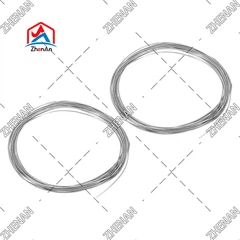
Tantalum Wire, also called Ta Wire, is produced to precise specifications that define its dimensions, purity, mechanical properties, and surface quality for various industrial and scientific uses. The two main commercial grades are Tantalum Wire 99.95%​ (≥ 99.95 % Ta, ultra‑high purity) and Pure Tantalum Wire Ta ≤ 99.9%​ (≤ 99.9 % Ta, cost‑effective).
Diameter range: Commercially available diameters span from 0.005 mm (5 µm)​ for ultra‑fine applications (microelectronics, medical sutures) to 3.0 mm​ for industrial heating elements and reactor components. Tolerances are typically ±0.001 mm for fine wires and ±0.01 mm for larger diameters.
Purity:
Tantalum Wire 99.95%​ - tantalum content ≥ 99.95 %, total impurity ≤ 0.05 %.
Pure Tantalum Wire Ta ≤ 99.9%​ - tantalum content ≤ 99.9 %, total impurity ≤ 0.1 %.
Mechanical properties​ (annealed condition):
Tensile strength: 200–300 MPa.
Elongation at break: 20–30 %.
Elastic modulus: ~186 GPa.
Surface finish: Options include bright annealed, matte, or etched (etched surface increases area for capacitor anodes).
Form: Supplied in straight lengths, coils, or spools; packaging in vacuum or inert gas to prevent oxidation.
Electrical resistivity: ~13.1 µΩ·cm for 99.95% grade; slightly higher for ≤ 99.9%.
These specifications allow matching the wire to performance needs-ultra‑fine, high‑purity Tantalum Wire 99.95%​ for critical electronics and biomedical implants, and larger, lower‑purity Pure Tantalum Wire Ta ≤ 99.9%​ for robust industrial use.
Specification
Range / Value
Notes
Diameter
0.005–3.0 mm
Tighter tolerance for fine wires
Purity
99.95% or ≤99.9%
Determines application class
Tensile strength
200–300 MPa (annealed)
Higher if cold worked
Elongation
20–30 %
Excellent ductility
Surface finish
Bright, matte, etched
Etched for capacitor use
Packaging
Vacuum/inert gas
Prevents contamination


What Are the Industry Standards for Tantalum Wire?

Tantalum Wire​ is governed by international and national standards that ensure quality, safety, and performance consistency across suppliers. These standards specify requirements for chemical composition, mechanical properties, dimensions, and testing methods for both Tantalum Wire 99.95%​ and Pure Tantalum Wire Ta ≤ 99.9%.
ASTM International
ASTM B365​ – Standard specification for tantalum and tantalum alloy rod and wire. Covers permissible impurity levels, dimensions, and mechanical properties for various grades including 99.95% and ≤ 99.9% purity.
ASTM F560​ – Standard specification for tantalum and tantalum alloy surgical implants, relevant for Tantalum Wire 99.95%​ used in medical devices.
ISO Standards
ISO 13782​ – Implants for surgery – Metallic materials based on tantalum; ensures biocompatibility and purity for medical Tantalum Wire.
ISO 6892‑1​ – Metallic materials – Tensile testing; used to verify mechanical properties of Ta Wire.
Other National Standards
GB/T 14841​ (China) – Chemical composition and test methods for tantalum wire.
JIS H 4701​ (Japan) – Tantalum and niobium materials, including wire specifications.
These standards define:
Chemical composition limits​ (e.g., max Fe, Ni, W, Nb).
Dimensional tolerances​ for diameter and straightness.
Surface quality​ (no cracks, pits, excessive oxidation).
Testing requirements​ (chemical analysis, tensile tests, metallography).
Compliance with these standards assures users that Tantalum Wire​ meets rigorous quality benchmarks for critical applications such as aerospace, medical implants, and high‑reliability electronics.
Standard
Scope
Relevant Purity Grade
ASTM B365
Rod & wire composition & properties
99.95%, ≤99.9%
ASTM F560
Surgical implant materials
99.95%
ISO 13782
Surgical implants – metallic materials
99.95%
ISO 6892‑1
Tensile testing methods
Both grades
GB/T 14841
Chinese chemical composition & test
Both grades
JIS H 4701
Japanese Ta/Nb materials
Both grades


What Are the Differences Between Pure Tantalum Wire and Alloy Tantalum Wire?

Pure Tantalum Wire​ (including Tantalum Wire 99.95%​ and Pure Tantalum Wire Ta ≤ 99.9%) consists almost entirely of tantalum with only trace allowable impurities, giving it distinctive properties: excellent corrosion resistance, high melting point (3017 °C), biocompatibility, and stable oxide formation (Ta₂O₅).
Alloy Tantalum Wire​ contains deliberate additions of other elements (e.g., tungsten, niobium, molybdenum, hafnium) to modify characteristics such as strength, high‑temperature creep resistance, or fabricability.
Key differences:
Aspect
Pure Tantalum Wire
Alloy Tantalum Wire
Composition
≥ 99.9% Ta (≤ 0.1% impurities)
Ta + alloying elements (e.g., 2–10% W)
Corrosion resistance
Outstanding in acids, alkalis, molten salts
Slightly reduced; depends on alloying element
Melting point
3017 °C (unchanged)
May decrease slightly with some alloys
Mechanical strength
Good, but lower than some alloys
Higher tensile and creep resistance at high T
Ductility
Very high; easy to draw fine
Often lower; harder to form into fine wire
Applications
Electronics (capacitors), medical implants, vacuum systems
Aerospace structural parts, high‑stress furnace components
Cost
Higher for 99.95% due to refining
May be higher or lower depending on alloy rarity
Example alloys:
Ta‑W (tantalum‑tungsten): Higher strength and creep resistance at > 2000 °C, used in rocket nozzles.
Ta‑Nb (tantalum‑niobium): Improved fabricability and superconducting properties.
While Pure Tantalum Wire 99.95%​ is preferred where chemical purity and biocompatibility are paramount, Alloy Tantalum Wire​ is selected when mechanical performance under extreme stress or temperature outweighs the need for ultra‑high purity.
 
Tantalum Wire FAQ

Professional customised Dia 0.1-5 mm Bright surface Tantalum wire

9995 Pure Tantalum Wire
Pure Tantalum Wire Made In China
Capacitor grade tantalum wire Free Sample
Pure Tantalum Wire For Sale

Q: What are common testing methods for tantalum wire quality control?
A: Dimensional inspection, chemical analysis (ICP-OES), tensile testing, surface examination, and resistivity measurement.

Q: How to store tantalum wire to prevent moisture damage?
A: Keep in sealed, desiccated containers away from humidity and corrosive vapors.

Q: Why is tantalum wire used in critical aerospace wiring systems?
A: Offers high corrosion resistance, reliability in extreme temperatures, and lightweight strength.

Q: How does tantalum wire support miniaturization of electronic devices?
A: Allows fine diameters with stable properties, fitting compact high-performance designs.

Q: What is the role of tantalum wire in radiation resistant components?
A: Maintains mechanical and electrical stability under high radiation exposure.

Q: How to determine the melting point of tantalum wire?
A: Use high‑temperature optical pyrometry or differential thermal analysis under controlled atmosphere.

Q: What is the use of tantalum wire in specialized welding electrodes?
A: Provides inert, high‑temp electrode material for reactive metal welding.

Q: How does tantalum wire perform in cryogenic environments?
A: Retains ductility and strength, showing no embrittlement at low temperatures.


Visit https://www.zhenanmetal.com to learn more about the product. If you would like to know more about the product price or are interested in purchasing, please send an email to info@zaferroalloy.com. We will get back to you as soon as we see your message.

Get a Quote Today

Customized 99.95% Pure Melting Tantalum crucible from ZhenAn

who choose us?


OEM Services
We provide customized services to meet customer requirements.
Product Customization
Size range: Customization supported
Pure metal wires of various sizes can be tailored to specific needs.
Label Customization
Custom labels available for product branding.
Packaging Customization
Multiple packaging options based on customer requirements.

one-stop solution

professional team

high quality