What Are the Purity Grades of Tantalum Wire?

Dec 15, 2025

Leave a message


What Are the Purity Grades of Tantalum Wire?

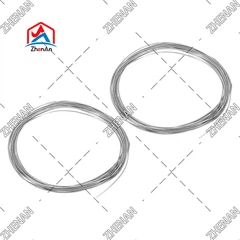
Tantalum Wire, also known as Ta Wire, is produced in defined purity grades to match application requirements for chemical purity, mechanical performance, and cost. The two most commercially significant grades are Tantalum Wire 99.95%​ and Pure Tantalum Wire Ta ≤ 99.9%.
Tantalum Wire 99.95%​ denotes wire with a tantalum content of at least 99.95 %, meaning total impurity levels are ≤ 0.05 %. This ultra‑high purity is achieved through advanced refining methods such as zone refining​ and multiple-pass powder purification, removing trace metals (Fe, Ni, W, Mo) and non‑metallic inclusions. The result is a wire with extremely low levels of electrically active or catalytically active contaminants, making it ideal for high‑vacuum electronics, medical implants, and aerospace components where even minute impurities could cause failure or signal noise.
Pure Tantalum Wire Ta ≤ 99.9%​ covers wires with purity up to 99.9 % tantalum, corresponding to impurity levels ≤ 0.1 %. This grade omits certain high‑cost purification steps, retaining trace elements that generally do not impair performance in less critical environments. It is widely used for chemical processing hardware, general‑purpose capacitors, and jewelry, where excellent corrosion resistance and biocompatibility remain necessary but ultra‑tight impurity control is not essential.
Both grades start from high‑purity tantalum powder derived from ore concentrates. The choice between them balances purity-driven performance​ against economic considerations. In controlled environments (e.g., implantable medical devices), Tantalum Wire 99.95%​ ensures long‑term stability and regulatory compliance. In industrial settings where mechanical robustness and corrosion resistance matter more than trace‑level purity, Pure Tantalum Wire Ta ≤ 99.9%​ delivers reliable service at lower cost.
Grade
Tantalum Content
Max Impurities
Key Features
Typical Applications
Tantalum Wire 99.95%
≥ 99.95 %
≤ 0.05 %
Ultra‑low contamination, excellent electrical/biological properties
Medical implants, aerospace, high‑vacuum electronics
Pure Tantalum Wire Ta ≤ 99.9%
≤ 99.9 %
≤ 0.1 %
Good corrosion resistance, cost‑effective for industrial use
Chemical processing, general capacitors, jewelry


What Is the Diameter Range of Tantalum Wire?

Tantalum Wire​ is available in a broad diameter range​ thanks to tantalum's excellent ductility, which allows it to be drawn to very fine sizes without fracturing. Typically, diameters span from a few micrometers (µm)​ to several millimeters (mm), depending on the intended use and starting material grade.
For Tantalum Wire 99.95%, common diameters for high‑precision applications are 0.01 mm to 1.0 mm. Ultra‑fine wires below 0.01 mm (10 µm) are produced for microelectronics, sensor leads, and specialized medical sutures, where exact dimensions and surface finish are critical. These fine wires retain the high purity and smooth surface finish needed to prevent signal interference or biological reaction.
Pure Tantalum Wire Ta ≤ 99.9%​ is generally supplied in diameters from 0.05 mm to 3.0 mm, targeting industrial components like furnace heating elements, valve springs, and chemical reactor stirrer filaments. Larger diameters are used where mechanical strength under high temperature or corrosive attack is required, and the slightly higher impurity tolerance does not affect performance.
The achievable diameter depends on the number of drawing passes, die material (diamond for fine sizes), and intermediate annealing steps to restore ductility. Controlling diameter tolerance tightly (±0.001 mm for fine wires) ensures consistent electrical resistance, mechanical behavior, and compatibility with automated assembly processes.
Diameter Range
Typical Applications
Preferred Purity
0.005–0.01 mm (5–10 µm)
Microelectronics, sensor leads, fine medical sutures
Tantalum Wire 99.95%
0.01–1.0 mm
Capacitor leads, pacemaker leads, aerospace filaments
99.95% (precision), 99.9% (less critical)
1.0–3.0 mm
Heating elements, valve springs, reactor stirrers
Pure Tantalum Wire Ta ≤ 99.9%


How Does Tantalum Wire Compare With Other Metal Wires?

When compared with other metal wires (e.g., tungsten, molybdenum, platinum, copper, stainless steel), Tantalum Wire​ stands out for its unique combination of properties shaped by its purity grades (Tantalum Wire 99.95%, Pure Tantalum Wire Ta ≤ 99.9%).
Melting point: Tantalum's 3017 °C is higher than molybdenum (2623 °C) and platinum (1768 °C), and far above copper (1085 °C) and stainless steel (~1400–1500 °C). Only tungsten (3422 °C) surpasses it. This makes Tantalum Wire superior for ultra‑high‑temperature applications.
Corrosion resistance: Tantalum forms a stable Ta₂O₅ layer, giving it exceptional resistance to acids (HCl, H₂SO₄, HNO₃) and alkalis-far better than stainless steel and copper, and comparable to platinum. Tungsten resists many acids but can be attacked by strong alkalis at high temperatures.
Biocompatibility: Tantalum is non‑toxic and osseointegrates with bone; platinum is also biocompatible but far more expensive. Copper and stainless steel can cause toxicity or allergic reactions.
Electrical conductivity: Tantalum's conductivity (~10% of copper) is lower than copper and aluminum but adequate for high‑temperature circuits; tungsten's conductivity is poorer (~30% of copper).
Mechanical ductility: Tantalum is highly ductile, allowing fine‑wire drawing; tungsten is brittle at room temperature, making fine-wire fabrication harder.
Cost: Tantalum Wire is more expensive than copper and stainless steel, less than platinum, and comparable to high‑purity tungsten. Tantalum Wire 99.95%​ carries a premium for critical applications, while Pure Tantalum Wire Ta ≤ 99.9%​ offers a mid‑range cost option.
Property
Tantalum Wire​ (99.95%/≤99.9%)
Tungsten Wire
Platinum Wire
Copper Wire
Stainless Steel Wire
Melting Point (°C)
3017
3422
1768
1085
~1400–1500
Acid Resistance
Excellent
Good
Excellent
Poor
Poor–Moderate
Biocompatibility
Excellent
Poor–Moderate
Excellent
Poor
Poor
Conductivity
~10% Cu
~30% Cu
~16% Cu
100% Cu (baseline)
~3% Cu
Ductility (fine wire)
High
Low (brittle RT)
Moderate
High
Moderate–High
Relative Cost
High–Very High
High
Very High
Low
Low–Moderate
 
Tantalum Wire FAQ

Professional customised Dia 0.1-5 mm Bright surface Tantalum wire

9995 Pure Tantalum Wire
Capacitor grade tantalum wire For Sale
Capacitor grade tantalum wire Free Sample
Pure Tantalum Wire For Sale

Q: What is the compatibility of tantalum wire with chemicals?
A: Resistant to most acids and alkalis, but attacked by hydrofluoric acid and fuming sulfuric acid.

Q: How to cut and shape tantalum wire?
A: Use precision tools, EDM, or laser cutting; avoid excessive force to prevent work‑hardening cracks.

Q: What is the thermal stability of tantalum wire?
A: Remains stable up to ~3000 °C in vacuum/inert gas, minimal property change with temperature.

Q: Why is tantalum wire suitable for high precision applications?
A: Consistent dimensions, excellent surface finish, and stable mechanical properties.

Q: What are market trends for tantalum wire?
A: Growing demand in electronics, medical devices, and aerospace; driven by miniaturization and reliability needs.

Q: How to prevent oxidation of tantalum wire during processing?
A: Use inert atmosphere or vacuum during heating and welding.

Q: What cost considerations when buying tantalum wire?
A: Purity grade, diameter, quantity, supplier, and market tantalum price.

Q: What key parameters to check before purchasing tantalum wire?
A: Purity, diameter tolerance, tensile strength, surface quality, and compliance with relevant standards.

Q: What innovations exist in tantalum wire manufacturing technology?
A: Improved continuous drawing, cleaner powder metallurgy, and additive manufacturing methods.

Q: What is the environmental impact of tantalum wire production?
A: Mining impacts; however, recycling reduces waste and energy use in production.

Q: How does tantalum wire contribute to electronic component reliability?
A: Its stability and corrosion resistance ensure long life and consistent performance in capacitors and sensors.

Q: How does tantalum wire perform under vacuum and air conditions?
A: Performs excellently in vacuum; in air, forms protective oxide above ~200 °C, limiting further oxidation.


Visit https://www.zhenanmetal.com to learn more about the product. If you would like to know more about the product price or are interested in purchasing, please send an email to info@zaferroalloy.com. We will get back to you as soon as we see your message.

Get a Quote Today

Customized 99.95% Pure Melting Tantalum crucible from ZhenAn

who choose us?


OEM Services
We provide customized services to meet customer requirements.
Product Customization
Size range: Customization supported
Pure metal wires of various sizes can be tailored to specific needs.
Label Customization
Custom labels available for product branding.
Packaging Customization
Multiple packaging options based on customer requirements.

one-stop solution

professional team

high quality