






Tantalum Wire Ta 99.95% – High-Performance Tantalum Alloy Wire
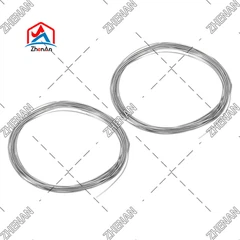
Tantalum Wire Ta 99.95% refers to tantalum wire that has been refined to a minimum purity level of 99.95%, with Ta representing the chemical symbol for Tantalum on the periodic table. This grade of wire is widely recognized for its exceptional physical and chemical properties, making it a preferred choice in high-demand environments.
Key Characteristics of Tantalum Wire Ta 99.95%
Applications of Tantalum Wire Ta 99.95%
High Purity Tantalum Wire 99.95% – FAQ
Q: What are recycling methods for used tantalum wire?
A: Melting and reprocessing via powder metallurgy or electron beam melting to recover pure metal.
Q: What is the role of tantalum wire in advanced battery technologies?
A: Used in current collectors and as a corrosion‑resistant substrate for solid‑state batteries.
Q: How to ensure uniform diameter in tantalum wire production?
A: Precision die control, consistent drawing speed, and real‑time monitoring.
Q: What are differences between annealed and cold worked tantalum wire?
A: Annealed is softer and more ductile; cold worked is stronger but less ductile.
Q: What is the use of tantalum wire in precision resistor manufacturing?
A: Its stable resistivity and low temperature coefficient suit high‑accuracy resistors.
Q: How does tantalum wire resist attack from molten metals?
A: Forms stable oxide layer and remains chemically inert to many molten metals.
Q: Why does tantalum wire maintain integrity at extreme temperatures?
A: Extremely high melting point and strong atomic bonds prevent degradation.
Q: How to select the right tantalum wire grade for chemical processing?
A: Choose high purity (e.g., 99.95%) and consider corrosion data for specific chemicals.
Q: What are applications of tantalum wire in high frequency electronics?
A: Used in inductors, RF connectors, and shielding due to stable electrical properties.
Q: How does tantalum wire enhance signal transmission in circuits?
A: Low resistive losses and stable performance over wide temperature range improve signal fidelity.
Q: What are common testing methods for tantalum wire quality control?
A: Dimensional inspection, chemical analysis (ICP-OES), tensile testing, surface examination, and resistivity measurement.
Q: How to store tantalum wire to prevent moisture damage?
A: Keep in sealed, desiccated containers away from humidity and corrosive vapors.
Q: Why is tantalum wire used in critical aerospace wiring systems?
A: Offers high corrosion resistance, reliability in extreme temperatures, and lightweight strength.
Q: How does tantalum wire support miniaturization of electronic devices?
A: Allows fine diameters with stable properties, fitting compact high-performance designs.
Q: What is the role of tantalum wire in radiation resistant components?
A: Maintains mechanical and electrical stability under high radiation exposure.
Q: How to determine the melting point of tantalum wire?
A: Use high‑temperature optical pyrometry or differential thermal analysis under controlled atmosphere.
Q: What is the use of tantalum wire in specialized welding electrodes?
A: Provides inert, high‑temp electrode material for reactive metal welding.
Q: How does tantalum wire perform in cryogenic environments?
A: Retains ductility and strength, showing no embrittlement at low temperatures.
Q: Why does tantalum wire have low thermal expansion coefficient?
A: Due to its strong metallic bonding and crystal structure, minimizing dimensional changes with temperature.
Q: How to improve the surface finish of tantalum wire?
A: Use precision drawing, electropolishing, or chemical polishing processes.
Q: What are applications of tantalum wire in high purity material synthesis?
A: Acts as container or heating element to avoid contamination in ultra‑pure processes.
Q: How does tantalum wire contribute to longer service life of components?
A: Resists corrosion and wear, ensuring durability in harsh conditions.
Q: Why is tantalum wire suitable for high voltage applications?
A: High dielectric strength and stable insulation properties under stress.
Q: How to calculate the weight of tantalum wire for a given length and diameter?
A: Use volume × density; Weight = π×(d/2)²×length×density (d in meters, density ~16.6 g/cm³).
Q: What is the use of tantalum wire in corrosion resistant fasteners?
A: Provides durable, non‑rusting fastening in aggressive chemical or marine environments.

Why Choose Tantalum Wire Ta 99.95%?
one-stop solution
professional team
high quality