




How to Calculate the Weight of Tantalum Wire for a Given Length and Diameter?


|
|
|
|
|---|---|---|
|
|
|
|
|
|
|
|
|
|
|
|
|
|
|
|
What Is the Use of Tantalum Wire in Corrosion Resistant Fasteners?
|
|
|
|
|---|---|---|
|
|
|
|
|
|
|
|
|
|
|
|
|
|
|
|
|
|
|
|
How Does Tantalum Wire Reduce Signal Loss in Communication Systems?
|
|
|
|---|---|
|
|
|
|
|
|
|
|
|
|
|
|
|
|
|
Tantalum Wire FAQ
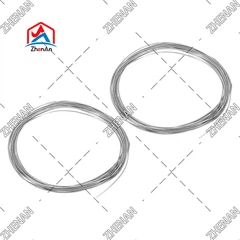
Professional customised Dia 0.1-5 mm Bright surface Tantalum wire


Q: What are challenges in machining tantalum wire for complex shapes?
A: Hardness, work hardening, and low thermal conductivity make cutting and drilling difficult.
Q: Why is tantalum wire non magnetic?
A: Its paramagnetic nature is extremely weak, effectively non‑magnetic for practical uses.
Q: How does tantalum wire support development of next generation semiconductors?
A: Enables contamination‑free high‑temp processes and reliable interconnects.
Q: What is the use of tantalum wire in precision instrument components?
A: Ensures accuracy and stability in measuring and control devices.
Q: How to verify the purity of tantalum wire?
A: Perform assay by ICP-MS/OES or GDMS against certified standards.
Q: What is the role of tantalum wire in high temperature sensor fabrication?
A: Withstands sensor operating temperatures while providing stable electrical connections.
Q: How does tantalum wire prevent contamination in sensitive processes?
A: Chemically inert surface avoids leaching or reaction with process materials.
Q: Why is tantalum wire ideal for vacuum sealing applications?
A: Low vapor pressure and hermetic sealing capability maintain vacuum integrity.
Q: How to handle tantalum wire safely during production and use?
A: Wear gloves, avoid inhaling dust, use eye protection, and prevent mechanical damage or moisture contact.
Q: What is the use of tantalum wire in advanced optical device components?
A: Provides stable, corrosion-resistant mounts and supports for lenses, mirrors, and detectors.
Q: How does tantalum wire enhance durability of industrial equipment parts?
A: Resists wear, corrosion, and high temperatures, extending part lifespan.
Q: Why is tantalum wire resistant to hydrogen embrittlement?
A: Forms a stable oxide layer that blocks hydrogen diffusion into the metal lattice.
Q: How does tantalum wire support sustainable manufacturing practices?
A: Recyclable, long service life, and enables energy-efficient high‑temperature processes.
Q: What are applications of tantalum wire in nuclear industry components?
A: Used in reactor instrumentation, corrosion‑resistant cladding, and radiation‑hard sensors.
Q: How to optimize the performance of tantalum wire in specific environments?
A: Select proper purity, surface finish, and match alloy type to chemical/temperature conditions.
Q: Why is tantalum wire chosen for high reliability electrical connections?
A: Stable conductivity, resistance to corrosion, and mechanical robustness ensure dependable joints.
Q: How does tantalum wire adapt to rapid temperature changes?
A: Low thermal expansion and high melting point minimize stress and distortion.
Q: What is the use of tantalum wire in custom engineered solutions?
A: Tailored dimensions and properties meet unique mechanical, chemical, or electrical needs.
Q: How does tantalum wire improve efficiency of energy storage systems?
A: Used in corrosion‑resistant current collectors and supports for longer cycle life.
Q: Why does tantalum wire have excellent creep resistance?
A: Strong atomic bonding and stable microstructure at high temperature limit deformation.
Q: How to assess the fatigue life of tantalum wire?
A: Perform cyclic loading tests under expected service conditions and analyze crack initiation.
Q: What is the use of tantalum wire in marine environment equipment?
A: Resists saltwater corrosion in sensors, fasteners, and underwater connectors.
Q: How does tantalum wire ensure consistent performance in batch production?
A: Uniform composition and mechanical properties give repeatable results.
Q: Why is tantalum wire critical for emerging technologies?
A: Combines high performance in extreme conditions with biocompatibility and reliability.
Q: What are applications of tantalum wire in high speed data transmission?
A: Used in low‑loss, stable signal paths for high‑frequency and RF systems.
Q: How does tantalum wire reduce maintenance needs in harsh conditions?
A: Long‑term corrosion and oxidation resistance cuts downtime and replacement frequency.
Q: Why is tantalum wire preferred for ultra pure chemical handling?
A: Does not leach contaminants, preserving chemical purity.
Q: How to design components using tantalum wire for maximum performance?
A: Optimize geometry, surface finish, and match grade to thermal, chemical, and mechanical loads.
Q: What is the use of tantalum wire in space exploration equipment?
A: Withstands extreme temperatures and vacuum, ideal for sensors and structural links.
Q: How does tantalum wire meet stringent regulatory requirements?
A: Produced to ASTM/ISO specs with documented purity and traceability.
Q: Why is tantalum wire a key material for future electronics?
A: Enables miniaturization, high reliability, and operation in demanding environments.
Q: How does tantalum wire enable precise control in manufacturing processes?
A: Stable physical and chemical behavior ensures repeatable process outcomes.
Q: What are applications of tantalum wire in advanced robotics components?
A: Used in actuators, sensors, and corrosion‑resistant joints for precision robots.
Q: How does tantalum wire enhance safety in high risk operations?
A: Reliable performance in extreme conditions reduces failure risk.
Q: Why is tantalum wire suitable for long term outdoor exposure?
A: Forms protective oxide layer, resisting weathering and corrosion.
Q: How to integrate tantalum wire into existing system designs?
A: Match dimensions, connection methods, and environmental specs to system requirements.
Q: What is the use of tantalum wire in cutting edge research equipment?
A: Provides inert, high‑precision components for analytical and synthesis instruments.
Q: How does tantalum wire support scalable production of high tech goods?
A: Consistent quality and availability enable reliable mass manufacturing.
Q: Why does tantalum wire remain indispensable in niche industries?
A: Its unique combination of corrosion resistance, high melting point, and biocompatibility meets critical needs unmet by other materials.
Visit https://www.zhenanmetal.com to learn more about the product. If you would like to know more about the product price or are interested in purchasing, please send an email to info@zaferroalloy.com. We will get back to you as soon as we see your message.

who choose us?
OEM Services
We provide customized services to meet customer requirements.
Product Customization
Size range: Customization supported
Pure metal wires of various sizes can be tailored to specific needs.
Label Customization
Custom labels available for product branding.
Packaging Customization
Multiple packaging options based on customer requirements.
one-stop solution
professional team
high quality