How to measure the resistivity of tantalum wire?

Dec 15, 2025

Leave a message


How to Measure the Resistivity of Tantalum Wire?​

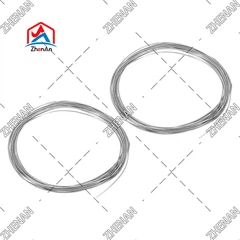
Measuring the resistivity of Wire Tantalum (Ta)-especially High Purity Tantalum Wire​ and Pure Ta Tantalum wire (99.95%)-is essential for verifying electrical performance and material consistency in capacitors, sensors, and high‑temperature circuitry.
Principle​
Resistivity (ρ) relates resistance (R), length (L), and cross‑sectional area (A):

info@zaferroalloy.com

where dis the wire diameter.
Step‑by‑Step Method​
Sample Preparation​
Cut a straight length of Wire Tantalum (Ta)​ (e.g., 10–100 cm) with no kinks.
Accurately measure length Lusing a calibrated ruler or laser distance meter.
Measure diameter dat multiple points with a micrometer or laser scanner to account for tolerances.
Electrical Setup​
Use a four‑point probe (Kelvin method)​ to eliminate lead resistance errors-critical for Pure Ta Tantalum wire (99.95%)​ where precise values matter.
Attach low‑contact‑resistance electrodes (gold‑plated clips or soldered terminals).
Connect to a precision ohmmeter or micro‑ohmmeter capable of resolving micro‑ohms.
Environmental Control​
Perform the test at a stable temperature (preferably 20 °C), recording ambient temperature to correct for resistivity variation.
Measurement & Calculation​
Record resistance R.
Calculate cross‑sectional area Afrom d.
Compute resistivity ρ.
Compare with reference: ~13.1 µΩ·cm for High Purity Tantalum Wire​ at 20 °C. Values significantly higher may indicate impurities or work hardening.
Accuracy Considerations​
Avoid surface contamination (cleans with isopropyl alcohol if needed).
Ensure uniform temperature during measurement.
Use calibrated equipment.
Step​
Action​
Prepare sample
Straight, measure L & d accurately
Setup
Four‑point probe, precision meter
Control environment
Constant T (~20 °C)
Calculate
ρ = R × A / L
Reference
~13.1 µΩ·cm for 99.95% Ta


What Are Recycling Methods for Used Tantalum Wire?​

Recycling Wire Tantalum (Ta), including High Purity Tantalum Wire​ and Pure Metal Tantalum wire, reduces reliance on scarce primary resources and supports conflict‑free supply chains.
1. Collection & Sorting​
Gather used Wire Tantalum (Ta)​ from scrapped electronics (capacitors, sensors), aerospace parts, and furnace components.
Separate from other metals using magnetic separation, eddy‑current methods, and manual sorting.
2. Mechanical Processing​
Cut or shred wire to increase surface area.
Remove polymer coatings or contaminants via thermal treatment or solvent cleaning.
3. Hydrometallurgical Extraction​
Leaching: Treat with HF/HNO₃ mixtures to form soluble fluoride complexes of tantalum.
Solvent Extraction: Separate tantalum from niobium and impurities using selective organic extractants.
Ion Exchange: Further purify the tantalum-bearing solution.
4. Recovery & Refining​
Precipitate as potassium fluorotantalate (K₂TaF₇) or tantalum oxalate; calcine to obtain high‑purity powder.
Powder can be consolidated and drawn into new Wire Tantalum (Ta), including Pure Ta Tantalum wire (99.95%).
5. Direct Re‑Drawing (Clean Scrap)​
For uncontaminated wire (e.g., from vacuum furnace elements), clean, vacuum anneal, and redraw without full chemical reprocessing.
Benefits​
Up to 70 % less energy use than primary production.
Reduces environmental impact of mining.
Supplies high‑purity feedstock for High Purity Tantalum Wire.
Stage​
Process​
Result​
Collection & sorting
Magnetic/eddy separation
Tantalum‑rich fraction
Mechanical processing
Cutting, cleaning
Prepared material
Chemical extraction
Leaching, solvent extraction
Pure Ta solution
Refining
Precipitation & calcination
Recycled Ta powder
Re‑drawing
Anneal & redraw
New Wire Tantalum (Ta)


What Is the Role of Tantalum Wire in Advanced Battery Technologies?​

Wire Tantalum (Ta)-particularly High Purity Tantalum Wire​ and Pure Ta Tantalum wire (99.95%)-supports advanced battery systems in critical auxiliary roles due to its chemical stability, conductivity, and high melting point.
Key Roles​
Current Collectors & Conductive Tabs​
Resists corrosion from aggressive electrolytes (organic carbonates, ionic liquids).
High Purity Tantalum Wire​ ensures low interfacial resistance and durability over thousands of cycles.
Battery Sensor Leads​
Used for in‑situ voltage/temperature monitoring within cells. Its corrosion resistance and signal stability make it ideal for harsh internal environments.
Solid Electrolyte Interface (SEI) Stabilization​
Forms a native Ta₂O₅ layer that can protect electrodes from parasitic reactions at high voltages, potentially extending cycle life.
High‑Temperature Battery Systems​
In aerospace or defense batteries operating at elevated temperatures, Pure Ta Tantalum wire (99.95%)​ retains mechanical and electrical integrity where copper or aluminum would fail.
Composite Electrode Additive​
Fine Wire Tantalum (Ta)​ can be blended into electrodes to improve electronic conductivity without undesirable chemical reactions.
Advantages​
Biocompatibility and chemical inertness align with safety goals for solid‑state and hybrid batteries.
High melting point supports high‑power pulse applications.
Application​
Role of Tantalum Wire​
Benefit​
Current collectors/tabs
Corrosion‑resistant conductor
Long life, stable performance
Sensor leads
Reliable signal in electrolyte
Accurate monitoring
SEI stabilization
Forms protective oxide
Suppresses degradation
High‑T batteries
Stable at high temperature
Prevents failure
Composite electrodes
Conductive additive
Enhanced conductivity
 
Tantalum Wire FAQ

Professional customised Dia 0.1-5 mm Bright surface Tantalum wire

9995 Pure Tantalum Wire
Capacitor grade tantalum wire For Sale
Capacitor grade tantalum wire Free Sample
Pure Tantalum Wire For Sale

Q: What cost considerations when buying tantalum wire?
A: Purity grade, diameter, quantity, supplier, and market tantalum price.

Q: What key parameters to check before purchasing tantalum wire?
A: Purity, diameter tolerance, tensile strength, surface quality, and compliance with relevant standards.

Q: What innovations exist in tantalum wire manufacturing technology?
A: Improved continuous drawing, cleaner powder metallurgy, and additive manufacturing methods.

Q: What is the environmental impact of tantalum wire production?
A: Mining impacts; however, recycling reduces waste and energy use in production.

Q: How does tantalum wire contribute to electronic component reliability?
A: Its stability and corrosion resistance ensure long life and consistent performance in capacitors and sensors.

Q: How does tantalum wire perform under vacuum and air conditions?
A: Performs excellently in vacuum; in air, forms protective oxide above ~200 °C, limiting further oxidation.

Q: What maintenance tips for tantalum wire in long term use?
A: Keep clean, avoid mechanical damage, store in dry inert environment, inspect regularly.

Q: What are common defects in tantalum wire and how to avoid them?
A: Cracks, inclusions, poor surface; avoid by strict process control and quality testing.

Q: What is the role of tantalum wire in capacitor production?
A: Forms anode leads and supports in tantalum electrolytic capacitors for reliable current flow.

Q: How to identify genuine tantalum wire from counterfeit products?
A: Verify purity via assay, check supplier certification, examine physical properties, and request material test reports.

Q: What is the impact of tantalum ore supply on tantalum wire price?
A: Limited ore supply raises tantalum metal cost, directly increasing tantalum wire price.

Q: What is the use of tantalum wire in high temperature furnace components?
A: Serves as heating elements, supports, and thermocouple sheaths due to high melting point and stability.

Q: Why does tantalum wire have high ductility?
A: Its body‑centered cubic structure allows extensive plastic deformation before fracture.

Q: How to calculate load capacity of tantalum wire in structural applications?
A: Use tensile strength and cross‑sectional area; factor in safety margin for operating conditions.

Q: What are standards for packaging and shipping tantalum wire?
A: Sealed, moisture‑free containers; labeled with grade, dimensions, and compliance info per ASTM/ISO guidelines.


Visit https://www.zhenanmetal.com to learn more about the product. If you would like to know more about the product price or are interested in purchasing, please send an email to info@zaferroalloy.com. We will get back to you as soon as we see your message.

Get a Quote Today

Customized 99.95% Pure Melting Tantalum crucible from ZhenAn

who choose us?


OEM Services
We provide customized services to meet customer requirements.
Product Customization
Size range: Customization supported
Pure metal wires of various sizes can be tailored to specific needs.
Label Customization
Custom labels available for product branding.
Packaging Customization
Multiple packaging options based on customer requirements.

one-stop solution

professional team

high quality