What Is the Use of Tantalum Wire in Heating Elements?

Dec 15, 2025

Leave a message


What Is the Use of Tantalum Wire in Heating Elements?​

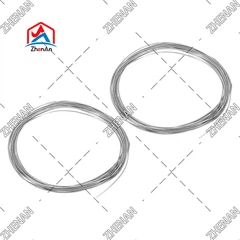
Wire Tantalum (Ta)​ is widely used in heating elements​ for high‑temperature applications because of its exceptional melting point (3017 °C), oxidation resistance in inert atmospheres, and ability to maintain mechanical strength at extreme temperatures. Both High Purity Tantalum Wire​ and Pure Ta Tantalum wire (99.95%)​ are chosen depending on the required level of purity and environmental conditions.
Key Applications​
Vacuum Furnace Heating Elements​ – In vacuum or argon atmospheres up to ~2000 °C, Pure Ta Tantalum wire (99.95%)​ provides uniform radiant heating without contaminating the load. Its low vapor pressure and minimal outgassing preserve ultra‑high vacuum (UHV) conditions critical for semiconductor and aerospace material processing.
Inert‑Gas Furnaces​ – Used in argon or nitrogen atmospheres for sintering ceramics, metals, and composites; tantalum resists corrosion and retains strength where nichrome or molybdenum would oxidize.
High‑Temperature Laboratory Equipment​ – Employed in research reactors and analytical instruments where chemical purity of the heating element is essential to avoid sample contamination.
Specialty Industrial Heaters​ – In chemical vapor deposition (CVD) reactors and hydrogenation units where resistance to aggressive gases is required.
Advantages in Heating Elements​
High melting point​ enables operation at temperatures far above those possible with nickel‑chrome or Kanthal.
Passive oxide layer​ (Ta₂O₅) protects against corrosion in inert atmospheres.
Low vapor pressure​ minimizes material loss and contamination in vacuum systems.
Ductility​ allows fabrication into complex coil shapes.
Application​
Why Tantalum Wire Is Used​
Preferred Grade​
Vacuum furnace heating
High T, low outgassing
Pure Ta Tantalum wire (99.95%)
Inert‑gas furnace
Oxidation resistance
High Purity Tantalum Wire
Lab equipment
Sample purity
Pure Ta Tantalum wire (99.95%)
CVD/Hydrogenation reactors
Corrosion resistance
High Purity Tantalum Wire


What Factors Affect the Tensile Strength of Tantalum Wire?​

The tensile strength​ of Wire Tantalum (Ta)-including High Purity Tantalum Wire​ and Pure Ta Tantalum wire (99.95%)-depends on several metallurgical and processing factors. Understanding these helps in selecting the right grade and condition for structural or electronic applications.
1. Purity Level​
Higher purity (Pure Ta Tantalum wire (99.95%)) generally results in more uniform mechanical properties and fewer internal defects, but may have slightly lower strength than heavily cold‑worked lower‑purity wire due to absence of strengthening impurities.
2. Degree of Cold Work (Work Hardening)​
Cold drawing increases dislocation density, raising tensile strength. Annealed Pure Metal Tantalum wire​ has ~200–300 MPa; heavily cold‑worked wire can reach 500–700 MPa. However, excessive work hardening reduces ductility and may cause brittleness.
3. Heat Treatment (Annealing)​
Vacuum annealing (1000–1400 °C) relieves internal stresses, restores ductility, and resets tensile strength to the annealed baseline. Partial annealing yields intermediate strength.
4. Grain Structure​
Fine, equiaxed grains from controlled recrystallization improve strength and toughness. Abnormal grain growth weakens the wire.
5. Diameter & Surface Condition​
Smaller diameters work‑harden more rapidly during drawing; surface defects (scratches, pits) act as stress concentrators, lowering effective strength.
6. Impurity Distribution​
Inclusions or second phases (carbides, nitrides) can either strengthen locally or initiate cracks, depending on size and location.
Factor​
Effect on Tensile Strength​
Purity
Higher purity → more uniform, sometimes lower ultimate strength
Cold work
Increases strength, reduces ductility
Annealing
Reduces strength, restores ductility
Grain structure
Fine grains → higher strength & toughness
Diameter & surface
Smaller & defect‑free → more uniform strength
Impurities
Can strengthen or weaken depending on distribution


Why Is Tantalum Wire Preferred for Vacuum Deposition Processes?​

Wire Tantalum (Ta), especially High Purity Tantalum Wire​ and Pure Ta Tantalum wire (99.95%), is the material of choice for vacuum deposition processes​ (e.g., evaporation, sputtering targets, boat liners) due to a unique combination of properties that preserve vacuum integrity and deposit high‑purity films.
Key Reasons​
Low Vapor Pressure​
At deposition temperatures (often 1500–2500 °C), tantalum's vapor pressure remains very low compared with tungsten or molybdenum, minimizing material loss from the source and contamination of the chamber.
Minimal Outgassing​
Pure Ta Tantalum wire (99.95%)​ has extremely low trapped gases (H₂, N₂, CO) due to high purity and vacuum sintering, reducing pump‑down time and base pressure in UHV systems.
Chemical Inertness​
The Ta₂O₅ passive layer and metallic tantalum resist reaction with residual gases (oxygen, water vapor) during heating, preventing formation of insulating or contaminant films on chamber walls.
High Melting Point & Strength​
Allows use as heating elements or crucibles for evaporating high‑melting metals/alloys without structural failure.
Deposited Film Purity​
Because the source material is ultra‑pure (High Purity Tantalum Wire), evaporated or sputtered films have fewer inclusions, yielding better electrical, optical, and corrosion properties.
Compatibility with Reactive Processes​
Can be used in reactive deposition (e.g., forming TaN, Ta₂O₅ coatings) without contaminating the process gas stream.
Property​
Benefit in Vacuum Deposition​
Low vapor pressure
Less source depletion, cleaner chamber
Low outgassing
Faster pump‑down, higher base vacuum
Chemical inertness
No reaction with residual gases
High melting point
Suitable for high‑T evaporation
High purity
High‑purity deposited films
Reactive gas compatibility
Enables compound film synthesis
 
Tantalum Wire FAQ

Professional customised Dia 0.1-5 mm Bright surface Tantalum wire

9995 Pure Tantalum Wire
Tantalum Niobium Alloy Wires Free Sample
Capacitor grade tantalum wire Free Sample
Pure Tantalum Wire For Sale

Q: What is tantalum wire?
A: Tantalum wire is a filament made from tantalum metal, known for high corrosion resistance and conductivity.


Q: What are the properties of tantalum wire?
A: It offers excellent corrosion resistance, high melting point, good ductility, and stable electrical properties.


Q: What are the applications of tantalum wire?
A: Used in electronics, aerospace, chemical processing, and medical implants.


Q: How is tantalum wire manufactured?
A: Made by drawing tantalum rod or ingot through dies to reduce diameter to desired size.


Q: What purity grades exist for tantalum wire?
A: Common grades include 99.9% (3N) and 99.95% (4N), with higher purities for critical uses.


Q: What is the diameter range of tantalum wire?
A: Typically from 0.05 mm to several millimeters, depending on application.


Q: How does tantalum wire compare to other metal wires?
A: More corrosion resistant than copper or nickel; less conductive but more stable in harsh environments.


Q: How is tantalum wire used in the electronics industry?
A: As capacitors, vacuum furnace components, and thin-film deposition targets.


Q: Is tantalum wire corrosion resistant?
A: Yes, highly resistant to acids and body fluids, except hydrofluoric acid.


Q: How does tantalum wire perform at high temperatures?
A: Stable up to about 3000°C in vacuum or inert gas, retains strength well.


Q: How to choose tantalum wire for specific applications?
A: Consider purity, diameter, mechanical needs, and environmental conditions.


Visit https://www.zhenanmetal.com to learn more about the product. If you would like to know more about the product price or are interested in purchasing, please send an email to info@zaferroalloy.com. We will get back to you as soon as we see your message.

Get a Quote Today

Customized 99.95% Pure Melting Tantalum crucible from ZhenAn

who choose us?


OEM Services
We provide customized services to meet customer requirements.
Product Customization
Size range: Customization supported
Pure metal wires of various sizes can be tailored to specific needs.
Label Customization
Custom labels available for product branding.
Packaging Customization
Multiple packaging options based on customer requirements.

one-stop solution

professional team

high quality