




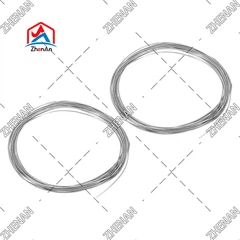


Pure Tantalum Wire 0.1 mm – Ultra-Fine Tantalum Wire for Precision Applications
🔹 Pure Tantalum Wire 0.1 mm – Overview
🔹 Key Features
🔹 Applications of Pure Tantalum Wire 0.1 mm
|
|
|
|---|---|
|
|
|
|
|
|
|
|
|
|
|
|
|
|
|
🔹 Why Choose Pure Tantalum Wire 0.1 mm?
🔹 Technical Summary Table
|
|
|
|---|---|
|
|
|
|
|
|
|
|
|
|
|
|
|
|
|
|
|
|
|
|
|
🔹 Tantalum Wire Ta 99.95% FAQ
Q: What is tantalum wire?
A: Tantalum wire is a filament made from tantalum metal, known for high corrosion resistance and conductivity.
Q: What are the properties of tantalum wire?
A: It offers excellent corrosion resistance, high melting point, good ductility, and stable electrical properties.
Q: What are the applications of tantalum wire?
A: Used in electronics, aerospace, chemical processing, and medical implants.
Q: How is tantalum wire manufactured?
A: Made by drawing tantalum rod or ingot through dies to reduce diameter to desired size.
Q: What purity grades exist for tantalum wire?
A: Common grades include 99.9% (3N) and 99.95% (4N), with higher purities for critical uses.
Q: What is the diameter range of tantalum wire?
A: Typically from 0.05 mm to several millimeters, depending on application.
Q: How does tantalum wire compare to other metal wires?
A: More corrosion resistant than copper or nickel; less conductive but more stable in harsh environments.
Q: How is tantalum wire used in the electronics industry?
A: As capacitors, vacuum furnace components, and thin-film deposition targets.
Q: Is tantalum wire corrosion resistant?
A: Yes, highly resistant to acids and body fluids, except hydrofluoric acid.
Q: How does tantalum wire perform at high temperatures?
A: Stable up to about 3000°C in vacuum or inert gas, retains strength well.
Q: How to choose tantalum wire for specific applications?
A: Consider purity, diameter, mechanical needs, and environmental conditions.
Q: What affects the price of tantalum wire?
A: Raw material cost, purity grade, diameter, quantity, and market demand.
Q: Can tantalum wire be customized?
A: Yes, length, diameter, surface finish, and packaging can be tailored.
Q: How should tantalum wire be stored and handled?
A: Keep in dry, contaminant-free environment; avoid scratches and mechanical damage.
Q: What welding methods suit tantalum wire?
A: TIG and electron beam welding are common due to its reactivity.
Q: What is the electrical conductivity of tantalum wire?
A: About 13% of IACS, lower than copper but sufficient for many specialized uses.
Q: What is the mechanical strength of tantalum wire?
A: Strong and ductile, with good fatigue resistance.
Q: What are common specifications of tantalum wire?
A: Include diameter, tolerance, temper condition, and surface quality.
Q: What industry standards apply to tantalum wire?
A: ASTM B365, ASTM F560, and others define dimensions and properties.
Q: What is the difference between pure and alloy tantalum wire?
A: Alloy types add elements like tungsten or niobium to improve strength or heat resistance.
Q: What is the use of tantalum wire in aerospace industry?
A: Used in high‑temperature sensors, structural components, and corrosion‑resistant fasteners.
Q: How to test quality of tantalum wire?
A: Conduct dimensional checks, chemical analysis, tensile tests, and surface inspection.
Q: What are the advantages of tantalum wire over other refractory metal wires?
A: Superior corrosion resistance, biocompatibility, and ease of fabrication.
Q: What are limitations of using tantalum wire?
A: High cost, lower electrical conductivity than copper, and reactivity with HF.
Q: How is tantalum wire surface treated?
A: Polishing, cleaning, or coating to improve appearance and corrosion resistance.
Q: What is the compatibility of tantalum wire with chemicals?
A: Resistant to most acids and alkalis, but attacked by hydrofluoric acid and fuming sulfuric acid.
Q: How to cut and shape tantalum wire?
A: Use precision tools, EDM, or laser cutting; avoid excessive force to prevent work‑hardening cracks.

who choose us?
Product Support & Export Experience
All our products support third-party inspections.
With 30 years of experience, we have extensive expertise in exporting Tantalum Wire to Europe.
Our considerable stock ensures short delivery times, and we offer flexible payment options, including TT and LC.
MOQ and samples: Negotiable.
one-stop solution
professional team
high quality